
Crystal Lake Epoxy Flooring installs basement floor epoxy in Crystal Lake, IL, serving surrounding cities including Lakewood, Lake in the Hills, Cary, Algonquin and Fox River Grove. In more than 20 years of coating local basements, the lesson that matters most is simple: the first question is never color. It is where the water is coming from.
A basement slab sits below grade, in contact with soil that holds moisture and, in much of this area, close to a shallow water table. Water and vapor can move up through the concrete, in through cracks or across the floor from a wall. A coating applied on top of that problem does not solve it. It traps it, and the floor eventually blisters, peels or turns white and chalky underneath.
So our basement work begins with an inspection and moisture testing written into the scope. When the slab is dry enough, we build a coating system that turns a gray, dusty floor into a bright, cleanable surface. When it is not, we say so plainly and point you toward fixing the water first, because a coating is not waterproofing and we will not sell it as if it were.
Water First, Coating Second
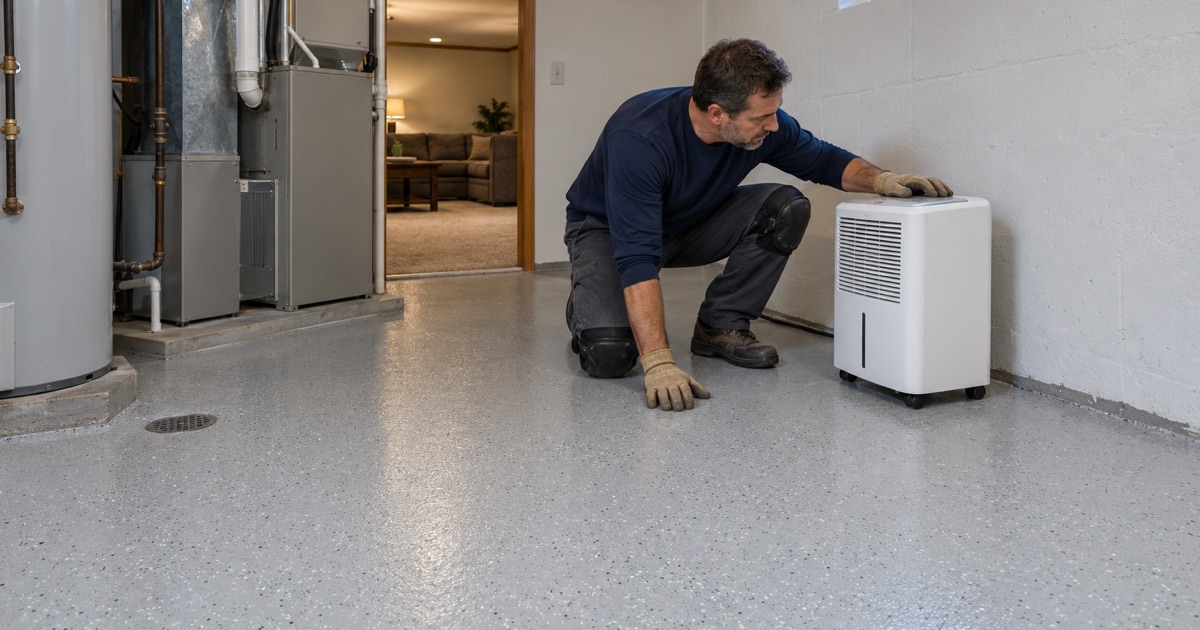
Finding Where the Water Comes From
We start by looking for evidence: stains along the walls, damp patches after rain, rust marks around the sump, white residue on the slab, musty corners and water lines on stored boxes. Each sign points to a different source, from a downspout dumping next to the foundation to a crack in the floor to groundwater rising under the slab.
Some of those sources are simple to fix, like extending a downspout or regrading a flower bed. Others call for drain tile, sump work or a waterproofing contractor. We tell you which kind of problem we see before we talk about coatings.
Hydrostatic Pressure and Vapor Drive
When groundwater rises around a basement, it presses up against the bottom of the slab. That hydrostatic pressure can push water through cracks and pores and will lift a coating off from below no matter how carefully it was applied.
Even without liquid water, moisture vapor moves through concrete from the damp soil toward the drier basement air. A slab poured without an effective vapor retarder underneath lets more of that vapor through. Both forces are why testing comes before any decision about a coating system.
Efflorescence as Evidence
Efflorescence, the white powder or crust you sometimes see on a basement floor, is mineral salt left behind as water moves through the concrete and evaporates at the surface. It is a stain, but more importantly it is a record of moisture moving through the slab.
We grind efflorescence off during preparation, and we treat it as a reason to test carefully. A slab that shows it needs a moisture reading before we choose a primer.
Testing a Basement Slab
The Plastic Sheet Screen
The ASTM D4263 plastic sheet test is simple: a sheet of clear plastic is taped tightly to the floor and checked later for condensation or darkened concrete. It is a quick screen, not a measurement, but it often shows right away whether a slab is moving moisture.
Calcium Chloride and Relative Humidity Testing
For real numbers we use ASTM F1869 calcium chloride testing, which measures the moisture vapor emission rate at the surface, or ASTM F2170 in-situ probes, which measure relative humidity inside the slab. Each gives a figure we can compare with what the primer and coating are rated to tolerate.
Those figures go in the proposal. You can see the readings, the limits of the products we propose, and why a moisture-mitigation primer is or is not part of the system.
When the Readings Are Too High
If the slab tests above what a standard primer handles but within what a mitigation primer is rated for, we add that primer to the system and price it in. It costs more, and it is the difference between a floor that lasts and one that lifts.
If the readings are beyond any product’s limits, or if liquid water is coming through, we do not coat. We would rather send you to fix the water and come back later than install a floor that is set up to fail.
Basement Floor Systems We Install
Epoxy Over a Moisture-Mitigation Primer
For most basements, the system is a diamond-ground slab, a primer chosen by the moisture results, a 100% solids epoxy body coat and a durable topcoat. This gives a seamless, bright floor that resists stains and wipes clean with a damp mop. We can add texture to the topcoat in laundry areas and near sinks, where water on a smooth floor would otherwise make it slick.
Flake and Metallic Finishes
A vinyl flake broadcast gives a basement floor a speckled, granite-like look that hides dust and minor blemishes. It is a practical choice for workshops, home gyms and storage areas.
For finished basements, family rooms and bars, a metallic epoxy creates a marbled, three-dimensional finish. It needs a flat, well-prepared slab and steady temperatures, and it rewards both with a floor that becomes the room’s centerpiece.
Polished Concrete as an Alternative
Some basements suit polished concrete better than a coating. Because a polished floor has no film on top, normal vapor moving through the slab has nothing to lift, which makes it forgiving in a lower level that tests on the damp side. We compare the two options with you after testing, including how each will look on your particular slab and what each costs per square foot.
Details Around Sumps, Drains and Walls
Sump Pits and Drain Tile
The sump pit is the heart of many local basements, and it has to stay accessible and working after the floor is coated. We bring the coating neatly to the edge of the pit, keep the lid removable and make sure nothing blocks the drain tile connections.
If the sump shows signs of trouble, such as a pump that runs constantly or a rusted discharge line, we point it out before coating, because a floor over a failing sump is a floor at risk.
Floor Drains and Laundry Areas
Floor drains need the floor to pitch toward them and the coating to stop cleanly at the drain rim. We never coat over a drain cover or cleanout, and we keep slopes intact so water still finds its way out.
Laundry rooms get extra attention, because washers leak and utility sinks overflow. A coated floor there makes cleanup fast, provided the texture keeps it from turning into a slip hazard.
Where the Floor Meets the Wall
The joint where a basement slab meets the foundation wall often moves slightly and can be a path for water. We leave that joint flexible rather than locking it in with rigid coating, and we can add a small cove or sealant joint to make cleaning easier.
Basements in and Around Crystal Lake
After the July 2017 Flooding
Shaw Local reported that 275 McHenry County homes had basements take on water in the July 2017 flooding, mainly in Crystal Lake and Lakewood. Floors that went through that kind of event need cleanup, time to dry out and a moisture test before any coating is considered.
We treat a basement coating as the last step after water problems are handled, never as a defense against the next storm. A coated slab is easier to clean after a water event, but it does not keep water out.
Groundwater, the Lake and the Creeks
Crystal Lake sits on outwash sand and gravel, and the lake itself is fed by groundwater. Homes near the lake and close to Crystal Creek and Woods Creek can sit nearer to groundwater than homes on higher ground, which raises the stakes for moisture testing. That is part of why we never skip testing on a local basement, even when a floor looks dry the day we visit.
Radon Is a Separate Job
Radon is a soil gas that enters basements through cracks and openings in the slab. A floor coating is not radon mitigation, and we do not sell it that way. In Illinois, radon mitigation is licensed by IEMA, and homeowners should test and hire a licensed mitigator if levels call for it.
Our Step-by-Step Basement Floor Epoxy Process
Step 1: Inspection and Testing
We look for water sources, map cracks and drains, and run moisture tests. The proposal lists the readings, the system and the warranty exclusions, with moisture first.
Step 2: Grinding and Repair
The slab is diamond ground with dust collection to remove paint, adhesive and weak concrete. Stable cracks are filled and pits patched.
Step 3: Primer and Body Coat
The primer chosen by the moisture results goes down first. The epoxy body coat and any flake or metallic finish follow.
Step 4: Topcoat and Handover
A topcoat seals the system. We go over cure times, care and what to watch for around the sump and drains.
- 20+ Years on Local Concrete
- Moisture Testing in Every Scope
- Written Per-Square-Foot Quotes