
Crystal Lake Epoxy Flooring installs industrial epoxy flooring in Crystal Lake, IL, serving surrounding cities including Lakewood, Lake in the Hills, Cary, Algonquin and Fox River Grove. In more than 20 years of floor work, we have coated plant floors, warehouses and loading areas where the floor is a piece of production equipment, and where a failure costs far more than the floor itself.
Industrial floors face forklifts with hard wheels, dropped parts and tools, pallets dragged across the slab, oils and coolants, cleaning chemicals, and in many cases temperature swings from open dock doors. A thin coating that looks fine at handover can wear through or delaminate within months under that kind of use. Industrial systems are built thicker and specified around the real loads and chemicals on the floor.
Every proposal we write for an industrial floor names the system, the finished thickness, the joint details and the schedule, priced per square foot. We also confirm the jurisdiction and the paperwork, because an industrial parcel with a Crystal Lake address may fall under a different authority.
Heavy-Duty Industrial Systems
High-Build Epoxy
High-build epoxy systems use multiple layers of 100% solids epoxy to create a thick, durable floor. They suit light manufacturing, assembly and warehouse areas with steady forklift and foot traffic. The build gives impact and abrasion resistance, and a chemical-resistant topcoat protects against the fluids and cleaners the floor sees every day.
Troweled Epoxy Mortar
Where floors take heavy impact, steel wheels or dragged loads, a troweled epoxy mortar adds much more thickness. It combines epoxy resin with graded aggregate and is troweled in place, then sealed. Epoxy mortar is also used to resurface damaged slabs, filling worn areas and restoring a flat working surface before the top layers go on.
Novolac Epoxy for Chemical Exposure
Standard epoxies can soften or stain under strong acids, solvents and some cleaners. Novolac epoxies are formulated for better chemical resistance and are often used in battery rooms, chemical storage areas and process zones. We match the system to your chemical list, considering concentration, temperature and how long spills might sit before cleanup.
Preparing Industrial Slabs
Shot Blasting and Heavy Grinding
Large industrial floors are usually prepared by shot blasting, which strips the surface and leaves a heavy profile suited to thick systems. Edges and areas around equipment are ground with diamond tooling. Dust is captured by the blasting and grinding equipment, and none of it is washed toward floor drains or storm inlets.
Oil-Soaked and Damaged Concrete
Years of oil and coolant can soak deep into an industrial slab and prevent bonding. We degrease, grind out contaminated surface concrete and test bond before coating. Areas too saturated to clean are cut out and patched. Spalls, potholes and broken joints are repaired with epoxy mortar so the new system sits on a sound base.
Moisture in Industrial Slabs
Older industrial slabs were often poured without an effective vapor retarder, and some sit near high groundwater. We test moisture before choosing a primer, because a delaminating floor under a production line is costly to fix.
Joints, Traffic and Safety
Control Joints Under Forklifts
Forklift wheels hammer control joints, chipping edges until the joints become trenches that damage wheels and jolt loads. We rebuild broken joint edges and fill joints with semi-rigid polyurea that supports wheels while allowing slight slab movement. Coatings are cut back at joints so any cracking follows the joint lines rather than running across the floor.
Safety Lanes and Markings
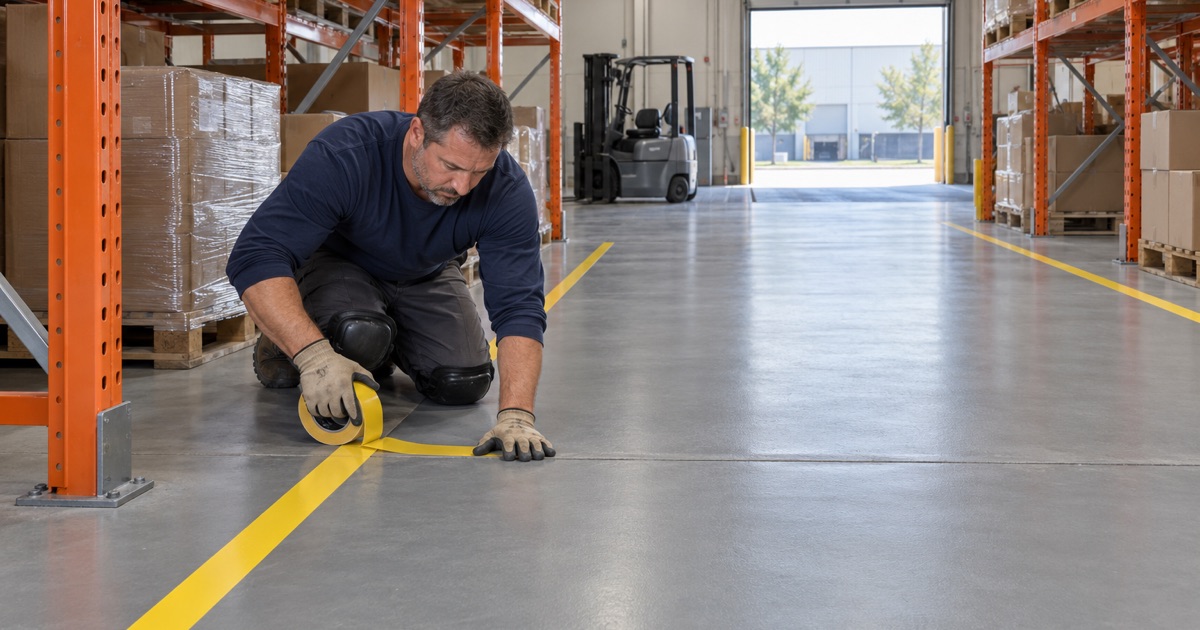
Industrial floors can carry forklift lanes, pedestrian walkways, hazard zones and equipment outlines as part of the coating system. Colors and layouts are agreed in advance to fit your safety plan.
Slip Resistance
Oil, coolant and water make smooth floors slick. We broadcast aggregate into the system where traction matters, adjusting texture so floors remain cleanable with your equipment.
Loading Docks and Temperature Swings
Docks and Winter Brine
Loading docks take truck traffic, pallet jacks and winter slush loaded with salt brine from trucks and trailers. Bare concrete there scales and spalls, and coatings need to handle both impact and salt. We build dock areas thicker, add texture for traction, and detail edges carefully where the dock plate meets the floor.
Cold Warehouses and Open Doors
Unheated warehouses and areas near open dock doors can be too cold for many coatings to cure properly. We measure slab temperature and the dew point spread before installation and schedule work for conditions the products require, or choose systems formulated for lower temperatures.
Working Around Production
Shutdowns and Phasing
Planned shutdowns are an ideal time for floor work. When there is no shutdown, we phase the floor around production lines and storage areas so the plant can keep operating.
Night and Weekend Crews
We schedule overnight and weekend shifts as needed and use fast-curing products where downtime must be short. The phasing plan is agreed in writing before work begins.
Rules and Jurisdiction for Industrial Floors
Illinois VOC Limits
Crystal Lake is within the Chicago 2015 ozone nonattainment area. Part 223 Subpart C of the Illinois Administrative Code caps VOC content at 340 grams per liter for industrial maintenance coatings and 250 for floor coatings, limits that bind the installer as well as the manufacturer.
Which Building Department Applies
Many industrial sites near Crystal Lake sit outside city limits even with a Crystal Lake mailing address. Some addresses on Route 31 fall in Prairie Grove, and some on Route 176 sit in unincorporated Nunda Township. We confirm which authority governs the parcel before quoting a schedule.
- 20+ Years on Local Concrete
- Moisture Testing in Every Scope
- Written Per-Square-Foot Quotes