
Crystal Lake Epoxy Flooring handles concrete floor repair in Crystal Lake, IL, serving surrounding cities including Lakewood, Lake in the Hills, Cary, Algonquin and Fox River Grove. Over more than 20 years, we have learned that most floor coating problems start with damage that nobody repaired properly before the coating went on.
Cracks, spalls, scaling, broken joints and failed old coatings each tell a story about the slab. Some are cosmetic and easy to fix. Others signal moisture, movement or a slab that has reached the end of its life. We read that story before quoting, and we say plainly when a floor needs repair or replacement before it can be coated.
Repairs can be stand-alone work or the first stage of a new coating or polished floor. Either way, the proposal spells out what will be repaired, with which material, and how much it adds per square foot, so the repair work is never a surprise on the final invoice.
Reading the Damage Before We Quote
Shrinkage Cracks Versus Moving Cracks
Nearly every slab cracks as it dries and shrinks, and those hairline cracks usually stabilize within the first year or two. They can be filled and coated over without much worry.
Cracks that keep growing, leak water, or have one edge higher than the other are different. They point to settlement, frost movement or water pressure, and we look for the cause before recommending a repair. A rigid patch across a moving crack will simply crack again.
Spalling and Salt Scaling
Spalling is when chunks of the concrete surface break away, often around joints, at edges or over corroded reinforcing. Scaling is the thinner flaking of the top layer that leaves sand and stone exposed, and in this area it is most often caused by salt and freeze-thaw cycles.
Both are common on older garage floors and loading areas. We grind back to sound concrete, patch the deeper spalls and protect the repaired surface with a coating so brine cannot keep working into it.
Failing Old Coatings
Peeling paint, lifted epoxy and patchy sealers are a kind of damage too. They usually failed because the slab was not prepared, moisture pushed from below, or the product was not suited to the use.
We test adhesion and grind away anything that is not firmly bonded. Recoating over a failing coating only adds a second layer to the next failure.
Residential Concrete Floor Repair
Garage Slab Repair
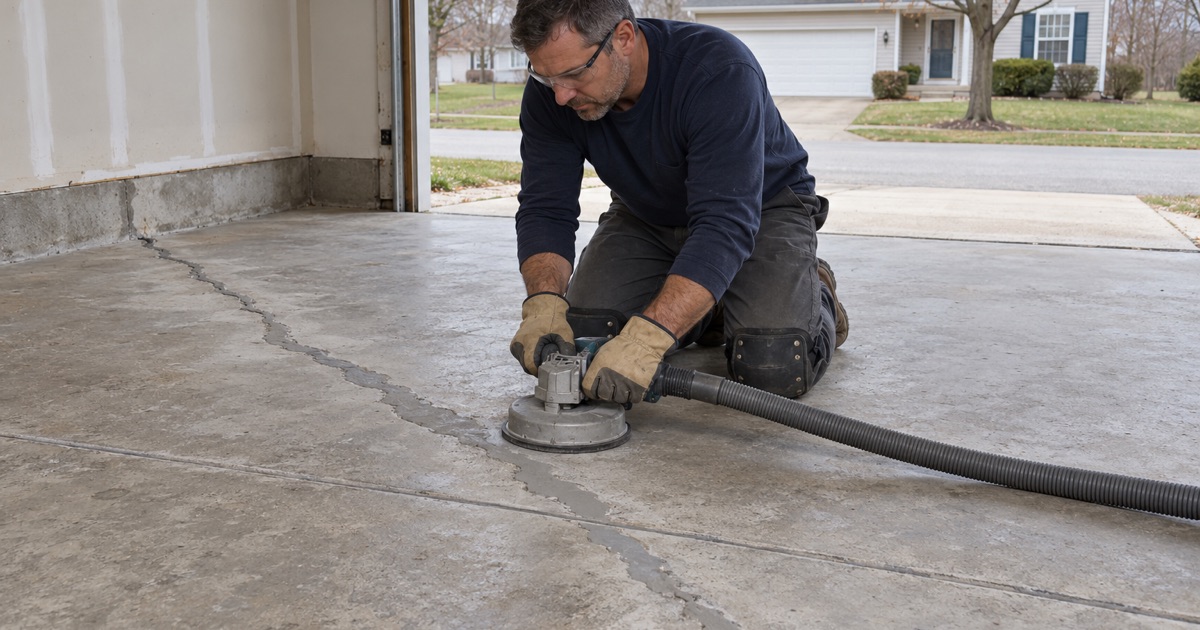
Garage floors here take years of brine, rock salt and freeze-thaw, and many show scaling near the overhead door and along the tire paths. Some have pitting where salt pooled, and older ones have cracks that run from corner to corner.
Our garage repairs grind off the weak surface, fill cracks with a semi-rigid polyurea, patch pits and spalls, and then prepare the slab for a coating that keeps the brine on top in future winters.
Basement Floor Cracks
Basement cracks need extra care because they can carry water. A dry, stable crack can be filled and coated over. A crack with water stains, efflorescence or seepage after rain needs the water source addressed first.
We never fill a leaking crack and coat over it as if the problem were solved. A coating is not waterproofing, and water pressure from below will push the repair and the coating off together.
Settled and Uneven Sections
Low spots, uneven patches from old repairs and slight lips at cracks are common on older slabs. We grind them down or fill them with patching mortar so the finished floor is smooth.
When a whole section has sunk or tilted, the base below it has usually moved. Surface patching cannot fix that, and we recommend lifting or replacing that section before investing in a coating.
Commercial Concrete Floor Repair
Joint Repair Under Forklift Traffic
In warehouses and plants, control joints take a pounding from forklift and pallet jack wheels. Unfilled or poorly filled joints chip at the edges until they form trenches that damage wheels and jolt loads.
We clean out the joints, rebuild broken edges with a structural repair mortar where needed and fill them with a semi-rigid polyurea filler that supports wheels while still allowing slight slab movement.
Spall and Pothole Repair
Heavy traffic, impacts and chemical exposure can create spalls and potholes in commercial floors. We saw-cut the edges, remove loose concrete and fill the repair with an epoxy or polymer mortar suited to the load.
Working around operations matters. We schedule commercial repairs in phases, including overnight and weekend windows, so the building can keep running.
Repairs Before a New Floor System
Before a tenant moves in or a facility upgrades to a coated or polished floor, the slab usually needs repair. Old adhesives, patched trenches and damaged joints all need to be addressed so the new system has a sound, flat base. We include that work in the same proposal as the finish, so the owner sees the full cost and schedule in one place.
Repair Materials We Use
Semi-Rigid Polyurea Fillers
Semi-rigid polyurea is our standard filler for control joints and many cracks. It is hard enough to support wheels and foot traffic but flexible enough to tolerate the small movements a slab makes through the seasons. It also cures quickly, which lets coatings go on soon after repairs are done.
Epoxy and Polymer Mortars
For deeper spalls, potholes and broken edges, we use epoxy or polymer-modified mortars that bond strongly to prepared concrete and build up thickness. The right mix depends on depth, traffic and whether the area will be coated, polished or left bare.
Urethane Cement for Hot and Wet Areas
In commercial kitchens and washdown areas, standard epoxies can fail under heat and moisture. Urethane cement mortars handle thermal shock and wet conditions, and they can be used both to repair and to resurface those floors.
When Repair Is Not Enough
Slabs That Need Replacing
Some floors have widespread deep cracking, large heaved or sunken sections, or deterioration that runs through the full depth of the slab. Patching those floors only delays the inevitable, and coating them wastes money.
When we see that, we say so before quoting a coating. Replacement work inside the city goes through the Crystal Lake Building Division and its ezAPP permit portal, under the 2018 IRC adopted in City Code Chapter 422, and the Division decides what needs a permit.
Honest Limits on Repairs
Repairs make a floor sound and smooth, but they cannot change what is under the slab. If water is rising from below or the base is washing out, the cause has to be fixed separately. Our job is to tell you which kind of problem you have, even when the answer means less work for us.
Our Step-by-Step Concrete Floor Repair Process
Step 1: Inspection
We map cracks, joints, spalls and old coatings and check for moisture and movement. Anything that points to replacement rather than repair is noted.
Step 2: Proposal
The written proposal lists each repair and the material we will use. It shows the cost per square foot or per linear foot, and any finish that follows.
Step 3: Repairs
Damaged concrete is cut out and cleaned, and cracks and joints are filled. Patches are built up and ground flush with dust collection.
Step 4: Finish or Handover
The repaired floor is then prepared for coating or polishing. If the repair was the whole job, we clean up and hand the floor back.
- 20+ Years on Local Concrete
- Moisture Testing in Every Scope
- Written Per-Square-Foot Quotes