
Crystal Lake Epoxy Flooring grinds and finishes polished concrete floors in Crystal Lake, IL, serving surrounding cities including Lakewood, Lake in the Hills, Cary, Algonquin and Fox River Grove. With more than 20 years working local slabs, we know that a polished floor is only as good as the concrete under it, so every job begins with a test grind rather than a promise.
Polished concrete is not a coating. We take the slab you already have, grind it with progressively finer diamond tooling, harden it with a lithium silicate densifier and refine it until it reflects light. The finished surface is the concrete itself, which means there is no film to peel, chip or blister.
That makes polished concrete a favorite for stores, warehouses, offices and showrooms that want a durable floor with low upkeep, and for homeowners who want a clean, modern look in a basement or a slab-on-grade living space. Our proposal states the grind depth, the densifier, the guard and the target sheen, priced per square foot for your floor.
Commercial Polished Concrete
Retail Stores and Showrooms
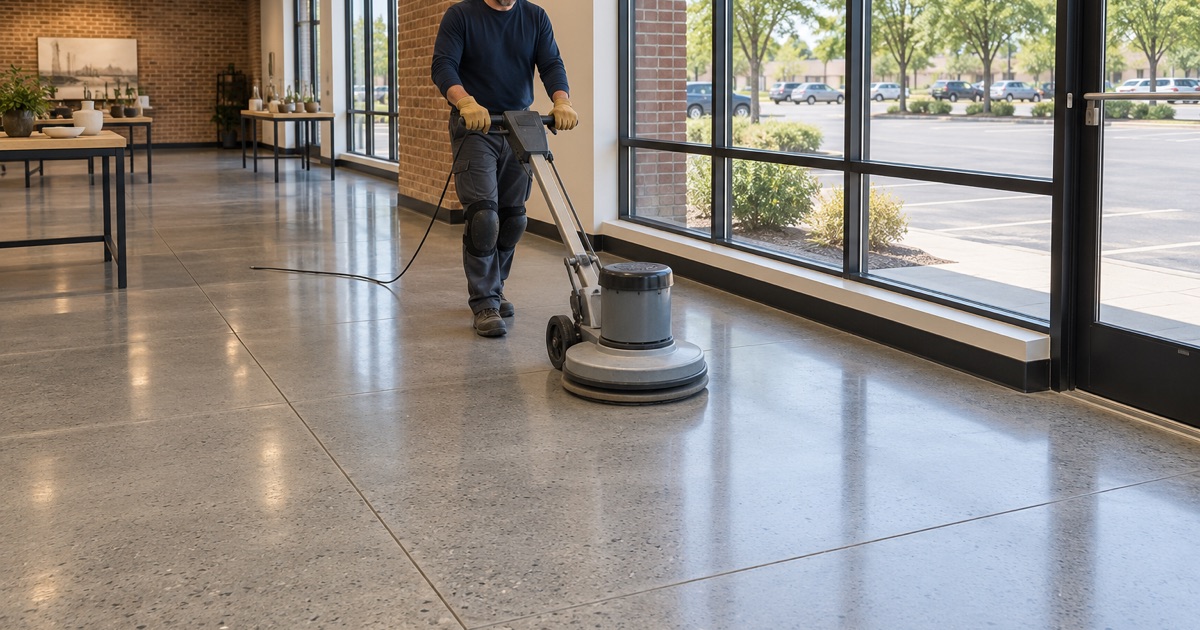
Retail floors take constant foot traffic, carts and display fixtures being dragged around. A polished floor stands up to that without the scuffed traffic lanes a coated or waxed floor develops, and it brightens the space by bouncing light back up from the floor.
For tenant turnovers we grind out old carpet glue, tile mastic and old coatings in the same process that polishes the floor. That is often faster than installing a new floor covering, which matters when a lease starts on a fixed date.
Warehouses and Distribution Floors
Warehouse slabs see forklifts, pallet jacks and dust all day. Densifying and polishing hardens the surface and cuts down on the concrete dust that a raw slab sheds, which keeps racking, products and equipment cleaner.
Control joints in a warehouse floor are filled with a semi-rigid polyurea before final polishing so forklift wheels roll over them without chipping the edges. We schedule large floors in sections, including overnight and weekend shifts, so operations can continue around the work.
Offices, Schools and Public Spaces
In offices and public buildings, polished concrete replaces carpet and vinyl with a floor that is easy to clean and has no seams to collect dirt. Maintenance usually comes down to dust mopping, damp cleaning and occasional burnishing.
Because there is no coating, there is no recoating cycle either. That changes the long-term cost picture for a building manager, even when the upfront price is similar to other options.
Residential Polished Concrete
Basements and Lower Levels
A polished basement slab gives a finished look without a floor covering that can trap moisture or mold. Since a polished floor has no film on top, normal vapor moving through the slab does not lift anything off, which is a real advantage over coatings in a damp lower level.
That does not mean polishing fixes water problems. Active leaks, seepage and hydrostatic pressure still need to be addressed at their source, and we look for those before we quote a basement floor of any kind.
Main Living Spaces on a Slab
Some newer homes and additions are built on a slab at grade, and polishing that slab can serve as the finished floor. It pairs well with radiant heating, because concrete holds and releases warmth evenly.
We can add color with penetrating dyes and leave borders or saw-cut lines to break up large areas. Area rugs soften the look in living rooms and bedrooms while the polished concrete handles kitchens and entries.
Aggregate Exposure, Color and Sheen
Cream, Salt and Pepper, or Full Aggregate
How deep we grind decides how much stone shows. A cream finish stays near the surface and shows little or no aggregate. A salt and pepper finish exposes fine sand and small stones across the floor, and a full aggregate grind cuts deeper to reveal larger stones.
The catch is that nobody can know exactly what is in an existing slab until it is opened. That is why we grind a test area first, show you what the stone looks like, and then confirm the finish in writing.
Dyes and Decorative Cuts
Penetrating dyes add color to polished concrete without creating a film. They can be used to tint the whole floor, separate areas or create logos and borders in a lobby.
Saw-cut lines can be laid out on a grid or follow existing control joints to turn a plain slab into a designed floor. Each decorative detail goes into the proposal before work begins.
Choosing the Right Sheen
Polished concrete can be finished from a low satin to a high gloss, depending on how far the diamond grits are refined and whether the floor is burnished. Higher sheen looks dramatic and bright, while a lower sheen hides scuffs and dust in busy spaces. We usually recommend a moderate sheen for commercial floors with heavy traffic and save the highest gloss for showrooms and spaces where the look is the point.
Polished Concrete and Local Conditions
Entryways and Winter Salt
Every winter, slush loaded with rock salt and calcium chloride brine gets tracked through the front doors of stores and offices around Crystal Lake. Left to dry on a polished floor, that brine leaves a white film and, over many seasons, can dull the surface near the doors.
Walk-off mats at every entrance, a stain guard kept in good shape and regular damp cleaning through the winter months keep salt from settling in. We cover that routine at handover, since the first winter is where a new polished floor either gets a good habit or a bad one.
Dust, Drains and Air Quality
Polishing produces fine concrete dust and slurry, and none of it belongs in a floor drain or storm inlet. Our grinders run with dust extraction, and any wet slurry is collected and disposed of rather than washed away.
Polished concrete also suits buildings that want to keep coatings and fumes to a minimum. Densifiers and guards are low-odor products, and there is no multi-coat resin system curing in the building, which makes the process easier to run in an occupied space.
Older Slabs in Older Buildings
A good share of the commercial stock around Crystal Lake has decades of patches, old floor coverings and repairs in the slab. Polishing reveals all of that rather than hiding it, so patched areas and old cracks will read through the finished floor.
Some owners like that history as part of an industrial look, and others want it minimized. We talk through what the test grind shows, where a dye or a grind depth can soften the patchwork, and when a coating would serve the space better than a polish.
Our Step-by-Step Polished Concrete Process
Step 1: Test Grind and Proposal
We inspect the slab, check its hardness and grind a sample area to reveal the aggregate. The proposal lists the grind depth, densifier, guard, sheen and any repairs, priced per square foot.
Step 2: Coarse Grinding and Repairs
Metal-bond diamonds flatten the surface, remove coatings and adhesives and expose the aggregate to the depth chosen. Cracks, joints and pits are filled before the finer grinds, and dust is collected at the grinder.
Step 3: Densifying and Refining
A lithium silicate densifier is applied to harden the surface. We then step through finer resin diamonds until the floor reaches the agreed sheen.
Step 4: Guard and Burnish
A penetrating stain guard is applied and burnished into the surface. We walk you through cleaning and maintenance before handing the floor back.
- 20+ Years on Local Concrete
- Moisture Testing in Every Scope
- Written Per-Square-Foot Quotes